
Brisbane summers are relentless. Between the punishing humidity that lingers well into autumn and electricity prices that seem to climb every quarter, your air conditioning system is one of the hardest working and most expensive assets in your home. So when it comes time to install or replace a unit, the temptation to grab the cheapest quote is understandable.
A bargain air conditioning installation can quickly turn into a costly mistake. A poor installation doesn’t just underperform, it drives up your power bills, shortens your unit’s lifespan, and in some cases creates genuine safety hazards inside your walls and ceiling. The “cheap” job ends up being the most expensive decision you make.
The difference between a system that runs beautifully for 15 years and one that causes headaches from day one almost always comes down to one thing, the quality of the air con installer. This guide walks through the seven most common installation mistakes we see in Brisbane homes and what you can do to avoid every single one of them.
Why Your Choice of Air Con Installer Matters More Than the Brand
Walk into any air conditioning showroom and the sales conversation quickly turns to brands inverter technology, star ratings, smart home integration. And yes, the unit you choose matters. But there’s a persistent myth that a premium brand is the golden ticket to a perfect outcome. It isn’t.
A $3,500 top-of-the-line split system installed poorly will perform worse than a mid-range unit installed correctly. The refrigerant lines, the drainage slope, the electrical connections, the positioning of both the indoor and outdoor units every one of these factors determines how well your system actually runs day to day. Get them wrong and even the world’s best compressor can’t compensate.
Brisbane’s climate adds another layer of complexity that generic installers often underestimate. High dew points mean your system has to work hard at dehumidification, not just temperature reduction. Coastal suburbs deal with salt-laden air that accelerates corrosion on outdoor components. A quality air con installer with genuine local experience accounts for all of this someone quoting blind over the phone simply cannot.
1. “Guess-timation” Instead of Heat Load Calculations
Sizing is everything in air conditioning. Get it wrong in either direction and you pay for it every single day. This is the “Goldilocks problem” too small, too large, and the consequences of both are equally frustrating.
An undersized unit never catches up. On a 35°C Brisbane afternoon, it runs continuously, the compressor works at maximum effort for hours on end, and your room still doesn’t reach a comfortable temperature. Your electricity bill reflects the punishment.
An oversized unit creates a different but equally unpleasant problem. It cools the air temperature quickly, but in doing so it short-cycles switching off before it’s had time to run through a full dehumidification cycle. The result is a room that feels cold but clammy. “Cold but sticky” is the classic complaint, and it’s a direct consequence of poor installation sizing.
Proper sizing requires a genuine heat load calculation, a methodical assessment that accounts for your room’s floor area, ceiling height, insulation, window orientation, glazing type, and even the number of people typically in the space. In Brisbane, local climate data (solar gain, humidity ratios, overnight temperatures) feeds into that calculation too.
Any air con installer who quotes a unit size without doing this assessment or who uses a rough square-metre rule of thumb without a site inspection is guessing. And you’ll be paying for that guess for the life of the system.
2. Obstructing the Outdoor Unit’s “Breathing Room”
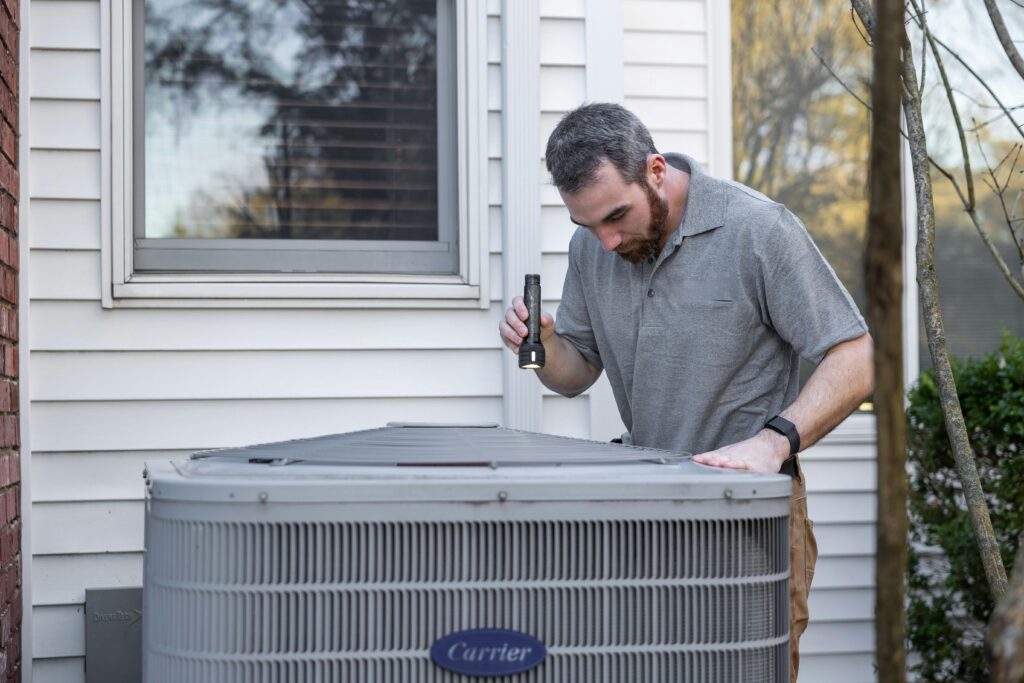
Your outdoor condenser unit has one main job, expelling the heat it pulls from inside your home out into the open air. Do anything to impede that process and you’re setting up the system for premature failure.
One of the most common poor installation choices we see is placing the outdoor unit in a tight side passage, a poorly ventilated utility alcove, or directly against a fence with no clearance. In these situations, the hot air the unit exhausts has nowhere to go, so it circles back and gets drawn into the condenser’s intake again. This is called recirculation, and it’s essentially the system rebreathing its own hot air.
The effect on the compressor is brutal. Operating in elevated ambient temperatures causes the compressor to run under chronic heat stress, the equivalent of a heart attack in slow motion. Compressor replacement is one of the most expensive repairs in air conditioning, often costing more than half the price of a new unit. In many cases, it makes more financial sense to replace the whole system.
A responsible air con installer assesses placement options during the site visit and recommends a location that provides adequate clearance on all sides and above the unit. Minimum clearances vary by manufacturer and model, but as a general guide, 600mm on the sides and 1.5 metres above the fan discharge are reasonable starting points. If the ideal spot isn’t available, the installer should discuss alternatives before proceeding, not after the brackets are already bolted to the wall.
3. Incorrect Indoor Unit Placement and Thermostat Interference
Where your indoor unit sits on the wall determines how well your thermostat sensor reads the room, and if that sensor is getting inaccurate readings, the entire system runs on false information.
Mounting a unit directly above a doorway is a classic mistake. Every time the door opens, a rush of warm air from the corridor hits the sensor and triggers the compressor to work harder, even though the rest of the room is comfortably cool. The system overcools the space and wastes power chasing a temperature spike that’s not representative of actual conditions.
Proximity to heat sources is equally problematic. Positioning the indoor unit near a kitchen, above an oven, or on a wall that receives direct afternoon sun through an unshaded window means the sensor consistently reads warmer than reality. The unit keeps running long after the room has reached the desired temperature, driving up energy consumption and wear on the compressor.
Good air conditioning install practice means choosing a wall position that gives the sensor a representative read of the room’s actual temperature, away from direct sunlight, heat appliances, doorways, and draughts. The distributor airflow also needs to reach the occupied zone of the room without being blocked by ceiling beams, bulkheads, or large furniture. These are details a rushed installer skips and a careful one never does.
The Hidden Dangers of Poor Installation: Water and Electricity
Beyond comfort and efficiency, poor installation creates two genuinely dangerous scenarios that Brisbane homeowners don’t always think about until real damage has already occurred.
Condensate Drainage Failures
Brisbane’s humidity is extraordinary. On a typical summer day, your air conditioner extracts several litres of water from the air as it operates so that moisture has to go somewhere. The condensate drain is what carries it safely outside. When that drain isn’t installed with the correct fall, a consistent downward slope from the indoor unit to the discharge point, water pools inside the drain tray and eventually overflows.
Where does it overflow? Into your wall cavity or ceiling. Water pooling inside building structures leads to mould growth, timber rot, and damage to plasterboard and insulation that can cost thousands to remediate. In worst-case scenarios, chronic moisture in wall cavities creates ongoing mould that affects your family’s health long after the visible damage has been repaired. A correctly sloped drain takes a few extra minutes to install properly, but the cost of getting it wrong is enormous.
Undersized Electrical Circuits
Many Brisbane homes, particularly those built before the 1990s have electrical infrastructure that was never designed to carry the load of modern high-capacity air conditioning. A standard 10-amp circuit that might have been adequate for a ceiling fan simply isn’t sufficient for a 6kW split system. An unscrupulous or inexperienced installer might connect the unit anyway, leaving the homeowner with a system that trips the breaker regularly or, more seriously, runs on an overloaded circuit that poses a genuine fire risk. Any air conditioning installed in an older Brisbane home should include an honest assessment of the existing electrical capacity and if an upgrade is required, that should be communicated clearly upfront, not discovered after the fact.
How to Spot a Quality Air Conditioning Install Before the Work Starts
You don’t need a technical background to distinguish a professional air con installer from one who will cut corners. A few straightforward checks before you sign anything tell you most of what you need to know.
ARC Licensing
Every technician who handles refrigerant in Australia must hold a current ARC (Australian Refrigeration Council) licence. This isn’t optional, it’s a legal requirement. Ask for the licence number before work begins and verify it at arctick.com.au. An unlicensed installation voids your unit’s manufacturer warranty and can expose you to fines if the work is ever inspected.
Transparent, Itemised Quotes
A professional installer provides a written quote that breaks down the cost of the unit, the installation labour, any required electrical work, and materials like refrigerant line sets and weatherproofing. Vague quotes with a single lump sum figure are a red flag. Hidden extras have a habit of appearing once work has started and you’re committed to an itemised quote removes that risk.
A Site Visit Before the Quote
Walk away from any installer who quotes entirely over the phone without seeing your home. Correct sizing, drainage routing, electrical assessment, and outdoor unit placement all require eyes on the actual space. A site inspection is how a quality installer gathers the information needed to do the job properly. It also gives you the chance to ask questions, assess their professionalism, and get a feel for whether this is someone you trust to work in your home.
Get Your Brisbane Air Con Installed Correctly the First Time
The cheapest quote rarely stays cheap. Undersized units, blocked outdoor condensers, poorly sloped drainage, overloaded circuits, and misplaced sensors every one of these mistakes has a financial consequence that compounds over the life of your system. Some of them create safety risks that no homeowner should have to deal with.
Getting your air conditioning installed right from day one means lower running costs, fewer repairs, a longer system lifespan, and a home that’s genuinely comfortable through Brisbane’s hardest months.
That outcome starts with choosing an air con installer who takes the job seriously, one who visits your home, calculates the right size, plans the installation properly, and stands behind their work.
Integrated Trade Services brings licensed expertise, local Brisbane knowledge, and a commitment to high standard installations that perform the way they should. Ready for a stress free summer? Contact our expert air con installers today for a professional assessment and get your system installed correctly the first time.
Frequently Asked Questions (FAQs)
Is it illegal to install my own air conditioner in Brisbane?
Yes. In Australia, it is a legal requirement that anyone handling refrigerant gases must hold an ARC (Australian Refrigeration Council) licence. A DIY installation not only voids your warranty but can lead to heavy fines and safety risks.
How do I know if my air conditioner was installed poorly?
Common signs of a poor installation include water dripping from the indoor unit, unusual vibrating noises from the outdoor unit, or the system taking an unusually long time to cool the room despite being brand new.
Will a bad installation really increase my electricity bill?
Absolutely. If a unit is poorly positioned or incorrectly sized, it has to work significantly harder to reach the set temperature, consuming much more power than an efficiently installed system.
How long should a professional air conditioning install take?
A standard back-to-back split system installation usually takes between 3 to 5 hours. More complex ducted systems or multi-head units can take a full day or more.